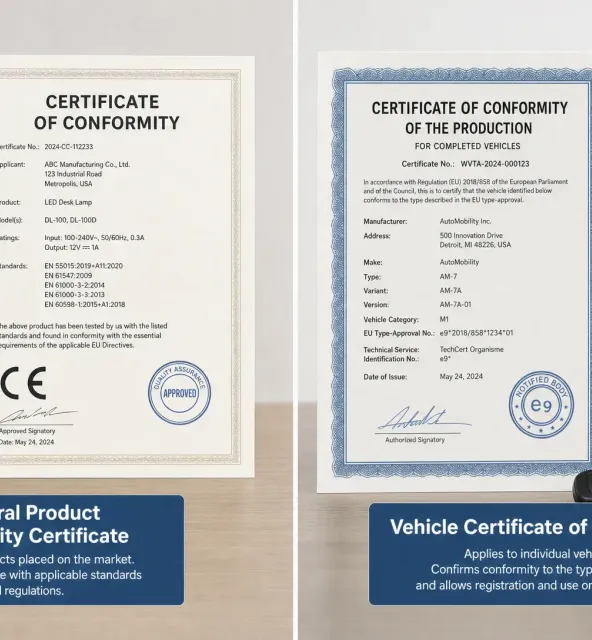
Product Certificate of Conformity vs Vehicle COC
JUMP AHEAD IN THIS ARTICLE
If you are trying to import, sell, register, or prove compliance for something in Europe, the phrase “certificate of conformity” can quickly become confusing. A product certificate of conformity and a vehicle COC both prove that something meets required standards, but they are not interchangeable.
The difference matters. The wrong document can delay customs clearance, block a vehicle registration appointment, or leave you going back to the manufacturer for a corrected certificate. This guide explains what each document means, who issues it, when it is used, and how to know which one you actually need.
The short answer
A product certificate of conformity is a broad compliance document used for many types of goods, such as electronics, machinery, construction products, medical devices, textiles, or industrial components. It usually confirms that a product, batch, or shipment meets specific technical standards, contract requirements, or regulatory rules.
A vehicle COC, short for vehicle Certificate of Conformity, is a much more specific document. It is issued for an individual vehicle and confirms that the vehicle matches an approved EU type. In practical terms, it helps registration authorities verify that a car, motorcycle, van, or other eligible vehicle can be registered in an EU country.
So, if you are dealing with general goods, you may need a product certificate of conformity. If you are registering an imported vehicle in Europe, you usually need a vehicle COC.
What is a product certificate of conformity?
A product certificate of conformity is a document that states a product complies with a defined set of requirements. Those requirements may come from EU legislation, international standards, national rules, industry specifications, a purchase contract, or customs documentation.
The phrase is broad, which is why it can mean different things depending on the product and the market. For example, a certificate for an electrical device may refer to safety and electromagnetic compatibility standards. A certificate for machinery may refer to mechanical safety requirements. A certificate for construction materials may refer to performance, fire resistance, or structural standards.
In many cases, a product certificate of conformity is used in business-to-business transactions. A buyer, importer, distributor, or customs authority may ask for proof that the goods supplied match the declared standard. It may apply to one serial-numbered product, a product model, or an entire production batch.
It is also important not to confuse a product certificate of conformity with every other compliance document. In the EU, many CE-marked products require an EU Declaration of Conformity, where the manufacturer declares that the product meets applicable EU rules. The European Commission’s CE marking guidance explains that CE marking applies only to product categories covered by specific EU legislation.
Depending on the product, a certificate may be issued by:
- The manufacturer
- The importer or authorized representative
- An accredited testing laboratory
- A notified body
- A certification company
- A supplier, under contractual quality requirements
That flexibility is useful for trade, but it also means the document’s value depends on the applicable rule. A certificate that satisfies one buyer or customs office may not satisfy another authority if the product category requires a different form of proof.
What is a vehicle COC?
A vehicle COC is a Certificate of Conformity issued for a vehicle that has EU type approval. It confirms that the individual vehicle, identified by its VIN, conforms to the type approved by the manufacturer and can be registered under the relevant European framework.
Unlike a general product certificate, a vehicle COC is not just a quality statement. It is tied to vehicle registration. Registration authorities use it to check key technical and environmental information without having to inspect every detail manually.
A vehicle COC usually includes details such as the manufacturer, vehicle identification number, EU type-approval number, variant and version, dimensions, mass, engine data, fuel type, emissions information, noise levels, tire sizes, seating capacity, and other technical fields. If you want to see how this information is typically organized, 321COC has a detailed guide to the Certificate of Conformity format for vehicles.
The legal framework is also different. Vehicle COCs are connected to EU vehicle type approval rules. For modern vehicles, the EU framework is set out in legislation such as Regulation (EU) 2018/858, which covers the approval and market surveillance of motor vehicles and trailers.
In everyday situations, drivers most often need a vehicle COC when they import a car from one European country to another, register a used foreign vehicle, re-register a vehicle after moving, or resolve missing technical data in the local registration process. For a broader explanation, see this guide on what a Certificate of Conformity is for car owners.
The key differences, without the paperwork jargon
The easiest way to separate the two documents is to look at their purpose.
A product certificate of conformity answers this question: “Does this product or shipment meet the required standard?”
A vehicle COC answers a more specific question: “Does this individual vehicle match an EU-approved vehicle type, and can the registration authority use its data for registration?”
The scope is different as well. A product certificate can apply to almost any regulated or contract-controlled product. A vehicle COC applies to a specific vehicle and is linked to a unique VIN. This is why a generic certificate for a car model is usually not enough for registration. The authority needs the document that corresponds to the exact vehicle being registered.
The issuer can also differ. A product certificate may come from several types of organizations, depending on the product category and requirement. A vehicle COC is typically issued by the vehicle manufacturer or an authorized source for that brand. This is one reason registration authorities are often strict about format, origin, and data consistency.
The content is another major difference. A product certificate may list standards, test reports, batch numbers, product descriptions, inspection results, or conformity statements. A vehicle COC contains structured vehicle data needed for registration and type-approval verification.
Finally, the document’s acceptance depends on the authority reviewing it. A customs officer, procurement department, or distributor may accept a product certificate for trade purposes. A vehicle registration office usually needs a proper vehicle COC, not a general product compliance certificate, invoice, service record, inspection report, or CE document.
Which document do you need?
If your goal is to place a product on the market, satisfy a buyer, or clear a shipment, you are probably dealing with a product certificate of conformity or another product compliance document, such as an EU Declaration of Conformity.
If your goal is to register a vehicle in an EU country, you should focus on the vehicle COC. This is especially true when the vehicle was first registered in another country or when your local authority needs technical data to complete the registration file.
Common examples make the distinction clearer:
- You bought a used car in Germany and want to register it in France, Spain, Belgium, Italy, or another EU country. You likely need a vehicle COC.
- You import a shipment of electrical appliances for resale. You likely need product compliance documents, which may include a product certificate of conformity or EU Declaration of Conformity.
- You purchased a motorcycle abroad and the local registration office asks for EU type-approval data. You likely need a vehicle COC.
- You are supplying industrial components to a customer who requires proof of compliance with a technical standard. You likely need a product certificate or test documentation.
- You have a car part, accessory, or spare component. That part may have its own product compliance requirements, but it is not the same as a COC for the complete vehicle.

Why a product certificate of conformity usually cannot replace a vehicle COC
A general product certificate and a vehicle COC may sound similar, but they serve different legal and administrative purposes. This is the main reason one normally cannot replace the other.
A product certificate may confirm that a product meets a safety standard, a contractual specification, or a test requirement. It may be valid for a batch or model. But vehicle registration authorities are not only checking general compliance. They need specific type-approval and technical data for the exact vehicle.
For example, a product certificate may describe a “passenger vehicle model” or a “vehicle component,” but the registration office needs the VIN, version, variant, emissions figures, mass, engine details, and other standardized registration data. Without those fields, the authority may not be able to create or update the national registration record.
This is also why documents such as invoices, foreign registration certificates, roadworthiness inspections, and service booklets may help support your file but usually do not replace a COC when a COC is requested. They prove ownership, history, or condition, not necessarily EU type conformity for that specific vehicle.
There is another source of confusion: the words “conformity,” “compliance,” and “declaration” are often used casually. In vehicle registration, the exact document matters. If you are comparing a manufacturer declaration with a COC, the distinction is covered in more detail in 321COC’s guide to Declaration of Conformity vs COC for vehicles.
How to check whether your vehicle document is the right one
Before submitting paperwork to a registration authority, review the document carefully. A mismatch or missing field can create delays, especially for imported used vehicles.
A valid vehicle COC should normally be clearly connected to the vehicle and include the technical data the authority expects. Look for the VIN and compare it character by character with the VIN on the vehicle and registration papers. Check that the manufacturer and model details make sense. Review whether the document includes an EU type-approval reference and structured technical fields.
Also check the source. A registration office may reject an unofficial-looking document, a translation without the original, a generic model certificate, or a certificate that appears altered. If you are unsure, ask the registration authority what format it accepts before your appointment.
For product certificates, the checks are different. You should confirm that the document refers to the right product, batch, standard, test report, regulation, and issuer. If it is for EU market access, confirm whether the product category requires CE marking, a Declaration of Conformity, notified body involvement, or specific technical documentation.
Common mistakes to avoid
The biggest mistake is assuming that every “certificate of conformity” is the same document. The phrase is generic in product compliance but specific in the vehicle registration world.
Another common error is requesting a product certificate from a seller when the registration office has asked for a vehicle COC. A seller may provide a sales invoice, a technical sheet, or a manufacturer statement, but that may not satisfy the registration authority.
A third mistake is using a certificate for the wrong vehicle or the wrong market. Vehicle data must match the VIN and the version actually being registered. If the vehicle was not built for the EU market or does not have EU type approval, the process may require additional steps, such as national approval or individual inspection, depending on the country.
Finally, do not leave the COC until the day before your registration appointment. If the document is missing, incomplete, or needs to be ordered from an official source, it can take time to obtain.
FAQ
Is a product certificate of conformity the same as a vehicle COC? No. A product certificate of conformity is a broad document used for many types of goods. A vehicle COC is a specific document for an individual vehicle, used mainly for registration and EU type-approval verification.
Can I use a product certificate of conformity to register a car? Usually no. If the registration authority asks for a vehicle COC, it generally needs the official vehicle document with the VIN and technical type-approval data, not a general product certificate.
Who issues a vehicle COC? A vehicle COC is normally issued by the vehicle manufacturer or an authorized source for that brand. It must correspond to the exact vehicle, usually identified by the VIN.
When would I need a product certificate of conformity? You may need one when importing, selling, distributing, or supplying regulated goods, especially when a buyer, customs authority, or market surveillance body requests proof of compliance.
When would I need a vehicle COC? You may need a vehicle COC when registering an imported vehicle, moving a vehicle between European countries, re-registering a used vehicle, or providing missing technical data to a registration office.
Does CE marking replace a vehicle COC? No. CE marking relates to certain product categories under EU product legislation. A vehicle COC relates to vehicle type approval and registration data, so the two serve different purposes.
Need a vehicle COC, not a general product certificate?
If your registration office is asking for a Certificate of Conformity for a car, motorcycle, van, or another eligible vehicle, make sure you request the correct vehicle COC rather than a generic product certificate.
321COC helps drivers order official EU-compliant vehicle Certificates of Conformity online for many brands, with transparent pricing, secure checkout, fast delivery, Trustpilot reviews, and money-back protection. You can start by ordering an official vehicle Certificate of Conformity online and avoid delays caused by the wrong document.