Is a COC a Shipping Document for Imported Cars?
JUMP AHEAD IN THIS ARTICLE
When an imported car is on its way, paperwork can start to blur together. You may hear the term COC during the import process and wonder whether it belongs in the same folder as the bill of lading, customs declaration, or transport note.
The short answer is no: a COC is not a shipping document for imported cars. A vehicle COC, short for Certificate of Conformity, is a manufacturer-issued document that confirms the car conforms to an approved vehicle type, usually for registration purposes in Europe. It does not prove that a car was shipped, who transported it, what route it took, or whether customs duties were paid.
The phrase COC shipping document is therefore misleading in the context of imported cars. A COC can be important after import, especially when registering the vehicle, but it is not a substitute for transport or customs paperwork.
What a vehicle COC actually is
A Certificate of Conformity is a technical compliance document. For vehicles in the European market, it shows that a specific vehicle matches an approved type and meets the regulatory requirements attached to that approval.
The EU framework for vehicle approval is set out in Regulation (EU) 2018/858, which covers type approval and market surveillance for motor vehicles and related systems. In practical terms, the COC helps registration authorities verify that the car has the technical characteristics needed to be registered without repeating every approval check from scratch.
A vehicle COC typically relates to details such as the VIN, manufacturer, vehicle category, engine data, emissions information, weights, dimensions, and type approval references. If you want a deeper breakdown, 321COC has a dedicated guide explaining what a COC document includes for car registration.
What matters here is the role of the document. A COC answers a compliance question: does this car match an approved vehicle specification? It does not answer a shipping question: how was this car transported, declared, and delivered?
What counts as a shipping document for an imported car?
Shipping documents are used to move goods from one place to another, identify the parties involved, support customs procedures, and prove delivery or freight arrangements. They are logistics and trade documents, not vehicle type approval documents.
Depending on how the car is transported and from where it is imported, common shipping or import-related documents may include:
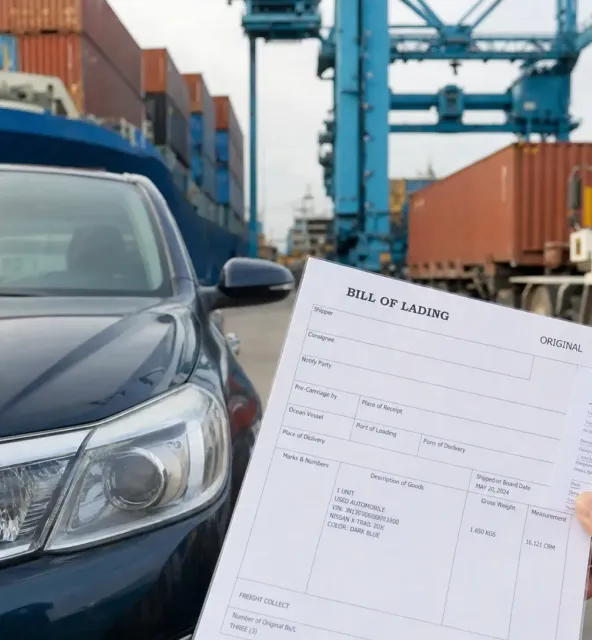
- Bill of lading or sea waybill: Used for ocean freight, identifying the vehicle, shipper, consignee, vessel, and shipment route.
- CMR consignment note: Commonly used for international road transport in Europe.
- Commercial invoice or purchase invoice: Shows the transaction value and seller-buyer details, often needed for customs and tax purposes.
- Export or deregistration document: May be issued by the country where the car was previously registered.
- Customs declaration and clearance papers: Used to declare the vehicle to customs authorities and show that import formalities were handled.
- Insurance or freight documents: Used to evidence coverage or transport arrangements during transit.
These documents help carriers, freight forwarders, customs brokers, port agents, and customs authorities do their jobs. A COC generally helps the registration authority do a different job later in the process.
Where the COC fits in the import journey
It helps to think of vehicle importation in stages. The COC usually becomes important after the car has been purchased, transported, and cleared for entry, when you are preparing to register it in the destination country.
During the purchase stage, you need documents that prove the transaction and ownership chain. During the transport stage, the carrier needs freight documents. During customs clearance, the authorities need import declarations, invoices, and any tax or duty information required for that situation. During registration, the national vehicle authority may ask for technical and compliance documents, which is where the COC often enters the process.
This is why you can sometimes ship a car without presenting a COC to the transport company, yet still be unable to register the car smoothly without one once it arrives. The transport company may care about the VIN, pickup and delivery points, payment, freight terms, and legal transport documents. The registration office may care about type approval, emissions category, technical specifications, and conformity.
If your main question is whether the document will be needed at the registration counter, see this guide on whether you need a COC to register an imported car.

Why people confuse a COC with a shipping document
The confusion is understandable. First, a COC is often mentioned during an import, so it feels like an import document. Second, some freight or customs agents may ask whether you have all vehicle documents before shipment, and the COC may be included in that general conversation. Third, the term certificate of conformity can mean different things in different industries.
In international trade, a certificate of conformity may sometimes be used as a product compliance document for shipped goods. But for an imported passenger car in Europe, the vehicle COC has a specific registration and type approval function. It is not the same as a freight certificate, customs certificate, certificate of origin, or bill of lading.
The distinction matters because using the wrong document in the wrong place can delay the process. A port agent cannot usually use a COC instead of a bill of lading. A registration authority may not accept a shipping document instead of a COC when technical conformity must be proven.
Can you import a car without a COC?
In many cases, physically importing or transporting a car does not require a COC. A carrier may be able to move the vehicle with the correct transport and ownership paperwork. Customs authorities may focus on import declarations, valuation, origin, taxes, and compliance with import rules.
However, registration is a separate step. If the destination country asks for a COC and you do not have one, the car may face delays, extra inspections, national approval procedures, or requests for alternative technical evidence. Requirements can vary by country, vehicle age, origin, prior registration status, and whether the model was originally built for the EU market.
A COC may be especially relevant when importing a car from one European country to another, re-registering a vehicle after purchase abroad, or proving that the vehicle meets EU type approval requirements. It may be less straightforward for older vehicles, heavily modified vehicles, or cars built for non-European markets, where a standard EU COC may not be available.
The practical lesson is simple: do not wait until your registration appointment to find out whether a COC is required. Ask the destination registration authority or check local rules before the car arrives, especially if you are working with tight deadlines.
Documents to prepare before and after the car arrives
A smooth import usually depends on having the right document for each stage. The exact list depends on the country and route, but this general structure helps avoid confusion.
Before or during transport, focus on transport and ownership paperwork. This may include the purchase invoice, previous registration certificate, export document, bill of lading, CMR note, transport booking, and insurance documents.
At customs, focus on declaration and tax paperwork. This may include the customs declaration, invoice, proof of payment, origin-related documents where relevant, and confirmation that duties or VAT were handled according to the applicable rules.
At registration, focus on vehicle identity and technical approval. This may include the previous registration certificate, proof of ownership, inspection documents if required, proof of insurance, tax documents, and the Certificate of Conformity when requested.
The COC belongs mainly in the last category. It can support the registration authority by providing standardized vehicle data, but it does not replace the transport or customs trail.
How to avoid delays when a COC is required
If you expect to register an imported car in Europe, treat the COC as a registration document that should be arranged early, not as a shipping form to be handled at the last minute.
Start by checking whether the car already has its original COC. If not, confirm whether the destination authority accepts a replacement or duplicate issued through the proper channel. Make sure the VIN and vehicle details match the car exactly. A small mismatch in the VIN, variant, version, or technical data can create problems during registration.
You should also check whether the vehicle is eligible for a standard COC. Cars built for the EU market are generally more likely to have an EU Certificate of Conformity available. Imported vehicles from outside the EU, modified vehicles, or vehicles without EU type approval may require a different route, such as national approval or an individual inspection.
If you need a broader explanation of the term itself, this 321COC guide covers the COC document meaning for car registration in more detail.
Frequently Asked Questions
Is a COC a shipping document? No. A vehicle Certificate of Conformity is not a shipping document. It confirms technical conformity for registration purposes, while shipping documents prove transport, delivery, freight arrangements, or customs-related facts.
Can a COC replace a bill of lading? No. A bill of lading or sea waybill is a transport document used in shipping. A COC does not prove that a carrier received, transported, or delivered the vehicle.
Do customs authorities require a COC for an imported car? Customs requirements vary, but customs authorities usually focus on import declarations, value, origin, taxes, and clearance documents. A COC is more commonly requested later by the registration authority.
Do I need the COC before the car is shipped? Not always for transport, but it is wise to check registration requirements before shipping. If the destination country requires a COC and you wait too long, registration may be delayed after arrival.
Is a COC proof of ownership? No. A COC is not proof of ownership. Ownership is usually supported by documents such as the purchase invoice, sales contract, previous registration certificate, or other documents required by the destination country.
What if my imported car does not have a COC? You may need to request an official COC if one is available for the vehicle. If it is not available, the registration authority may ask for alternative technical documentation, inspection, or national approval.
Need a COC for registration after import?
A COC may not ship your car, but it can be essential when you want to register it. If your registration authority asks for an official Certificate of Conformity, you can order one online through 321COC, with transparent pricing, secure checkout, and support for many vehicle brands across Europe.
Before placing an order, confirm that your destination authority requires a COC and that your vehicle details are accurate. That simple step can help you separate shipping paperwork from registration paperwork and avoid unnecessary delays after your imported car arrives.